The Invisible Drag on Your Business
Why Growth Feels Harder Than It Should

Sometimes Growth Is Not the Problem
Sometimes a business is not stuck. It is moving, serving customers, bringing in revenue, and creating new opportunities. The team is busy. The owner is working hard. From the outside, the company may appear healthy and successful.
Yet inside the business, everything feels heavier than it should.
Every new customer creates more follow-up. Every new project creates more details to track. Every new employee creates more questions. Every opportunity adds more coordination, more exceptions, and more pressure instead of more breathing room.
That is often a sign of invisible drag.
What Is Invisible Drag?
In engineering, drag is resistance that makes movement require more energy. The object may still move - and may even move quickly - but it consumes more force than necessary to maintain that progress.
Businesses can experience the same thing.
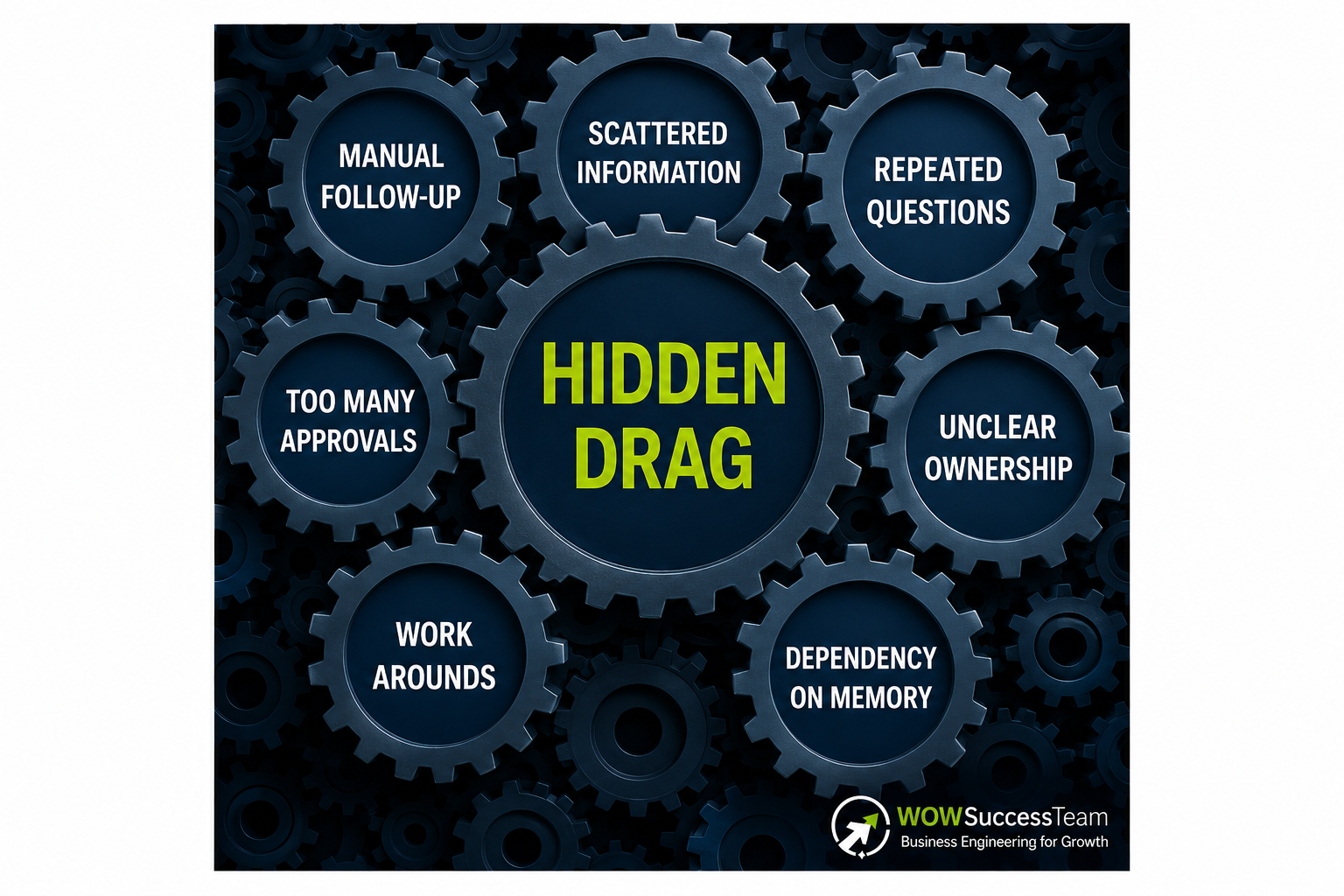
Invisible drag is the operational resistance that makes routine work take more time, attention, clarification, and effort than it should. It rarely announces itself as one dramatic failure. It usually appears as dozens of small delays, workarounds, interruptions, and dependencies that people learn to accept as normal.
It is the owner answering the same questions repeatedly. It is a team member waiting for clarification. It is customer information spread across several systems. It is follow-up that depends on memory. It is a process that works only because one person knows how to hold it together.
The business is moving - but it is paying an unnecessary energy tax for every mile of progress.
Growth Does Not Create the Drag. It Reveals It.
When a company is smaller, informal systems can work surprisingly well. The owner remembers the details. Team members ask quick questions. A spreadsheet is good enough. Manual follow-up mostly works. One experienced person knows the exceptions.
Those methods may not be wrong for that stage. The problem begins when the business grows but the operating methods do not.
More customers create more handoffs. More leads create more follow-up. More employees create more communication. More locations, products, services, and projects create more chances for information to be delayed, duplicated, or lost.
The company may not be failing. It may simply have outgrown the way work currently gets done.
Why Successful Companies Often Miss It
Capable owners and teams are very good at compensating. They remember what the system does not. They create spreadsheets. They send reminders. They text the missing information. They build workarounds. They step in before a customer notices a problem.
Because the work still gets done, the underlying friction can remain hidden for years.
This is especially common in established and multi-generational companies. The business may have deep expertise, loyal customers, and strong relationships while still relying on processes that evolved informally over time. Everyone knows how things are done - but the knowledge may live in people rather than in a reliable operating system.
Competence can hide drag. The better the people are at compensating, the longer the business can avoid seeing how much unnecessary effort the system requires.
What Invisible Drag Looks Like
Invisible drag often appears through patterns rather than one obvious breakdown. Common signs include repeated questions, delayed follow-up, unclear handoffs, information scattered across tools, frequent rework, inconsistent procedures, excessive owner approvals, manual copying and pasting, and work that slows down when one key person is unavailable.
Each issue may seem small in isolation. Together, they create a business that is slower, more fragile, and more dependent on individual memory and effort.
The most important question is not simply whether the work gets done. It is how much energy the business consumes to make sure it gets done.

Busy Is Not the Same as Scalable
A busy company can still be carrying significant operational drag. Activity does not automatically indicate efficiency, clarity, or scalability.
If people stay busy because they are chasing information, correcting preventable mistakes, waiting for approvals, updating multiple systems, or clarifying the same decisions, then busyness may be evidence of friction rather than growth capacity.
Scalability is not the ability to do more work by applying more pressure. It is the ability to make the right work easier to repeat with dependable quality.
Before You Push Harder, Look for Resistance
Owners often respond to growth pressure by working longer hours, hiring another person, adding another platform, or demanding greater effort from the team. Sometimes those actions are appropriate. But if the underlying workflow is already carrying drag, adding volume can multiply the friction.
Before pushing harder, ask where the business is resisting itself:
Those questions can reveal whether the company needs more effort - or a better way of working.
Reducing Drag Does Not Mean Rebuilding Everything
Operational improvement does not always require replacing every system or redesigning the entire company. Often, the first useful step is simply to identify where friction is concentrated.
One clear handoff, one better intake process, one documented decision rule, one connected workflow, or one removed manual step can begin reducing the energy required to operate.
The goal is not technology for technology's sake. The goal is a business that can move with more clarity, consistency, profitability, and confidence.
The Bottom Line
If your business is growing but feels harder to run, growth itself may not be the problem.
The problem may be the invisible drag inside the way work gets done.
Once you can see that drag, you can begin deciding what should be simplified, clarified, documented, connected, delegated, automated, or redesigned.
WOWSuccessTeam helps businesses examine the relationship between their operations, people, processes, and technology so they can remove unnecessary friction and engineer better ways to work.
Get Ready. Grow!
Start with the Hidden Business Drag Checklist and identify one area where work feels heavier than it should.
Schedule your strategy session