AI Agents Vs. Standard Automations: Which Is Better For Your Business?

The next time a critical workflow in your business breaks because a vendor changed a single field in a spreadsheet, or because a customer sent an email that didn’t fit your "exact" keyword trigger, ask yourself: Is your automation working for you, or are you working for your automation?
For companies in the $1M–$20M range: especially those in manufacturing, legacy services, and enterprise sectors: automation has long been the "holy grail" of efficiency. But there is a growing, expensive frustration in the C-suite. We’ve spent years building "standard automations" that act like rigid plumbing: they work perfectly until there’s a clog or a leak, at which point the entire system grinds to a halt, requiring a human to drop everything and fix the "logic."
Now, the conversation has shifted to AI Agents. Are they just the latest buzzword, or are they the "dynamic problem solvers" your business has been missing?
At WOWSuccessTeam, we don’t just follow tech trends; we engineer business solutions. If you are tired of "talking" about efficiency and ready to start "doing," understanding the difference between these two technologies is the first step toward a scalable, low-stress future.
The Deep Dive: Why "Standard" Automation Often Fails at Scale
Standard automation: think of tools that follow "If This, Then That" (IFTTT) logic: is deterministic. It relies on absolute rules. You tell the computer: "When a new order arrives in the CRM, create an invoice in the accounting software and send a 'Thank You' email."
This is excellent for high-volume, repetitive tasks where the data never changes format. It is the "reliable plumbing" of your business. However, for a $10M manufacturing firm or a legacy service provider, business is rarely that simple.
The Hidden Problem: The Maintenance Trap
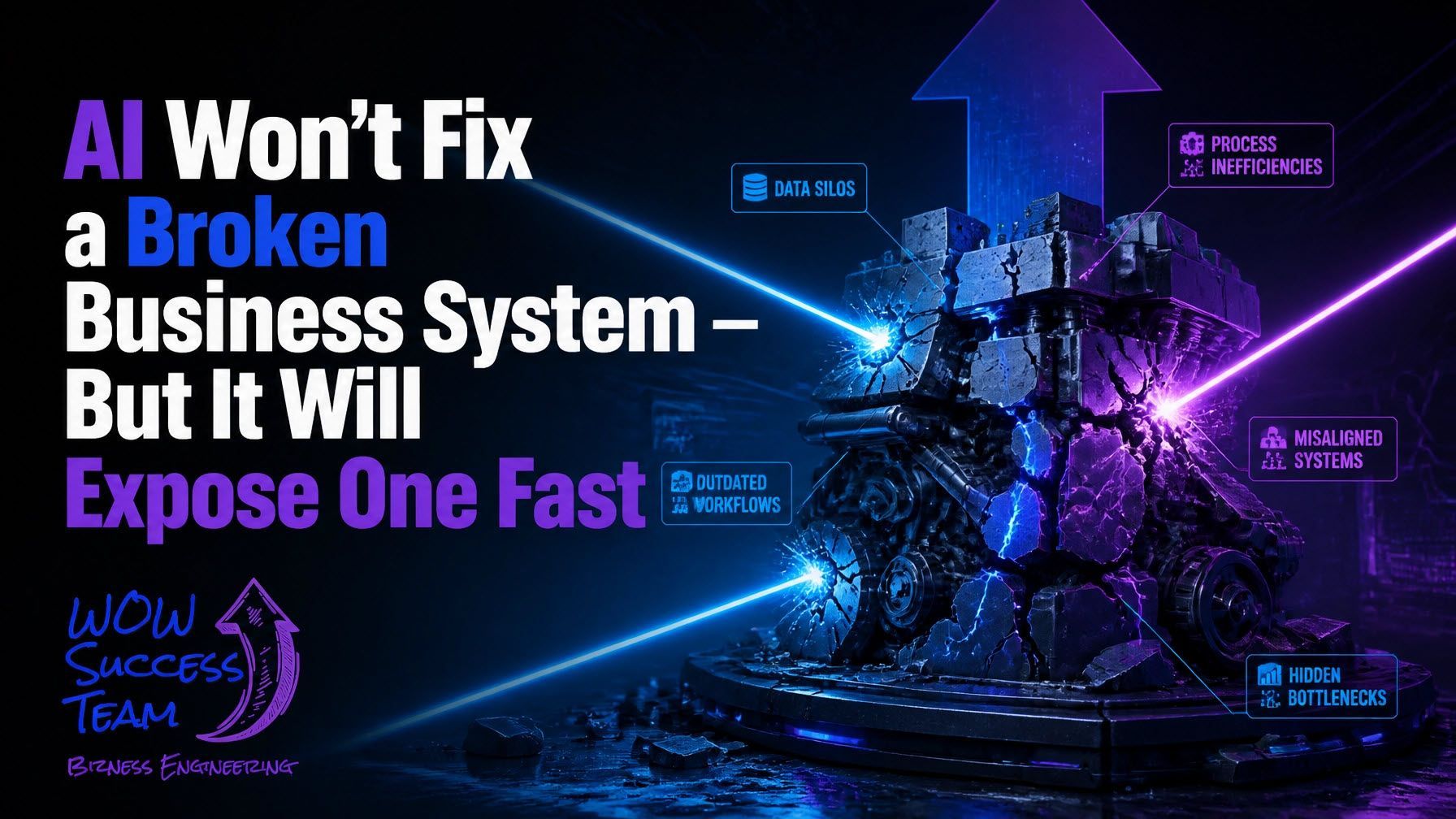
As your business grows, your "plumbing" becomes a labyrinth. You end up with hundreds of small scripts and "zaps" connecting disparate systems. The moment a software provider updates their API, or a supplier sends a PDF instead of a CSV, the logic fails. Because standard automation cannot "think," it cannot handle exceptions.
This leads to the Maintenance Trap: You hired automation to save time, but now you need a full-time staff member (or a very expensive consultant) just to monitor the automations and fix them when they break. You haven’t eliminated the work; you’ve just moved it from "data entry" to "system troubleshooting."

The "Why": The Hidden Cost of Manual Oversight
In a legacy enterprise, the cost of these "breaks" isn't just the hourly rate of the person fixing the script. The real cost is Operational Friction.
When a standard automation fails in a supply chain workflow, it might take 48 hours for someone to notice. In that time, parts aren't ordered, production lines slow down, and customer trust erodes. Manual oversight is the enemy of scale. If your business requires a human to "babysit" the technology meant to replace them, you haven't engineered a solution; you’ve built a digital crutch.
This is why mid-market firms often feel "stuck." They have the revenue to grow, but their internal systems are so fragile that adding more volume would cause a total collapse. They are reaching the limits of what deterministic logic can handle.
The Educational Solution: Plumbing vs. Thinking
To choose the right path, you must understand the fundamental difference between these two technologies.
1. Standard Automation (The Plumber)
- Nature: Deterministic.
- Logic: Fixed "If/Then" rules.
- Strength: Speed and reliability in stable environments.
- Weakness: Brittle. Breaks on any unexpected input.
- Best For: Payroll processing, simple data syncing, and form-to-email triggers.
2. AI Agents (The Dynamic Problem Solver)
- Nature: Probabilistic and Goal-Oriented.
- Logic: Reasoning and tool-use.
- Strength: Handles ambiguity, adapts to changes, and manages multi-step tasks.
- Weakness: Requires guardrails and "Business Engineering" to ensure accuracy.
- Best For: Supply chain exception handling, complex customer inquiries, and cross-platform project orchestration.
An AI Agent doesn't just follow a script; it follows a goal. If you tell an AI Agent to "Ensure the vendor has the latest specs," and the vendor’s portal is down, the Agent can "reason" that it should try sending an email or checking a backup server. It uses various tools (Email, CRM, File Storage) to achieve the outcome, rather than just failing at Step 1.

Real-World Examples: Automation in the Wild
Let’s look at how this plays out in a typical $15M Manufacturing firm.
Scenario: A Material Shortage
- Standard Automation: A sensor detects low inventory. It triggers an automated "Reorder" email to the primary vendor. The vendor replies saying that specific part is discontinued. The automation "completes" its task by sending the email, but no parts arrive. Production stops three days later when the shelf is empty.
- AI Agent: The Agent attempts to reorder. It receives the "discontinued" email. Instead of stopping, the Agent parses the email, understands the problem, searches the pre-approved secondary vendor list, checks for price parity, and sends a notification to the Purchasing Manager: "Primary vendor discontinued Part A. I have found an alternative at Vendor B for 5% more. Shall I proceed with the order?"
The Agent managed the exception, saved the production line, and only required the human for a high-level decision. That is Business Engineering in action.
Practical Application: Which Is Better For YOUR Business?
At WOWSuccessTeam, we are platform-agnostic. We don't care which "shiny" tool you use; we care about the result. Choosing between standard automation and AI Agents isn't an "either/or" decision: it’s about building a hybrid stack.
Use Standard Automation When:
- The process is 100% predictable.
- The data format never changes.
- The cost of a "break" is low.
- You need "real-time" speed (milliseconds) for high-volume transactions.
Use AI Agents When:
- The process involves "unstructured" data (emails, PDFs, voice notes).
- The workflow spans multiple systems that don't talk to each other well.
- The task requires a "judgment call" or exception handling.
- You want to reduce the "Human-in-the-Loop" for routine management tasks.
For most legacy and enterprise firms, the goal for 2026 should be to keep your "plumbing" (standard automation) for the foundation and layer AI Agents on top to act as the "Supervisors." This is how you move from a "System of Record" to a "System of Action."

Key Takeaways for the Strategic Leader
- Stop Over-Complicating: Don't use a complex AI Agent for a task that a simple script can handle. It increases costs and introduces unnecessary "hallucination" risks.
- Focus on Outcomes, Not Tools: Whether it's a CRM integration or a custom-built agent, the goal is always the same: Less Stress, More Action.
- The Human Still Matters: AI Agents don't replace your team; they allow your team to move from "doing the work" to "supervising the result."
- Audit Your "Brittle" Points: Identify the automations that break most often. Those are your primary candidates for an AI Agent upgrade.
Stop Talking. Start Engineering.
The gap between companies that "talk" about AI and those that "engineer" it into their operations is widening. If you are a business owner or executive managing a $1M–$20M firm, you don't have time to be a part-time tech hobbyist. You need systems that work as hard as you do.
Whether you need to fix your broken integrations, transition your hosting, or build a custom AI-driven workflow that actually delivers ROI, we can help.
Ready to see what's actually happening "under the hood" of your business?
Schedule your Business Engineering Discovery Call today.
Our team of experts will help you identify the "clogs" in your current systems and engineer a roadmap for scalable growth. Let’s get out of the weeds and back to the work that matters.
If you would like to do a deeper dive to discover how to overcome your growth struggles,
feel free to contact us or schedule an appointment.
Office:
307-206-9978 | Cell/WhatsApp:
808-346-0302
info@wowsuccessteam.com |
https://wowsuccessteam.com