AI Will Not Fix a Broken Process
Before you add another intelligent tool, make sure the work underneath it is clear enough to improve.

The problem is not always the tool
A lot of business owners are being told that AI will make work faster, smarter, and easier. Sometimes it can. But AI does not automatically repair a messy intake process, a vague handoff, a forgotten follow-up, or a team habit that lives only in someone's head.
If the process underneath the business is unclear, AI usually makes the problem move faster. It can generate more tasks, more notifications, more partial answers, and more places for things to fall through. That is not transformation. That is acceleration without direction.
The more practical question is this: where is the work already leaking time, leads, trust, or profit? Once that is visible, AI and automation can be used with much better judgment.
What a broken process looks like in real life
A broken process does not always look broken from the outside. The business may still be serving clients, answering calls, sending invoices, and getting work done. The warning sign is that too much of that work depends on memory, heroics, repeated explanations, or one person constantly stepping in to keep things moving.
You may see leads come in from the website, social media, referrals, and email, but no single intake path shows what happened next. You may have a CRM, but people still ask, "Did anyone call them back?" You may have project management software, but the real status update is still buried in a text message. You may have SOPs, but the team avoids them because they are outdated, too long, or disconnected from the way work actually happens.
These are not character flaws. They are system signals. The business is not necessarily disorganized. It may be undersystemized.
Why AI struggles when the process is unclear
AI is useful when it has enough context, structure, and boundaries to support the work. It can summarize notes, draft follow-ups, organize intake information, identify patterns, and help move routine work forward. But it needs a defined path to support.
If no one can clearly answer what happens after a lead submits a form, AI cannot make that workflow reliable. If the team does not agree on what qualifies as urgent, AI cannot make the priority system trustworthy. If every client handoff is slightly different because the process was never defined, AI may create polished output that still does not match the business need.
That is why AI-first does not mean AI-tools-first. A stronger approach is process-first, then AI-enabled. The business defines how the work should move. Then AI, automation, CRM, dashboards, SOPs, and integrations support that movement.

Start by finding the leak
Before adding another app or automation, look for the places where work slows down, repeats, disappears, or depends too heavily on one person. Those places usually point to the first process that needs attention.
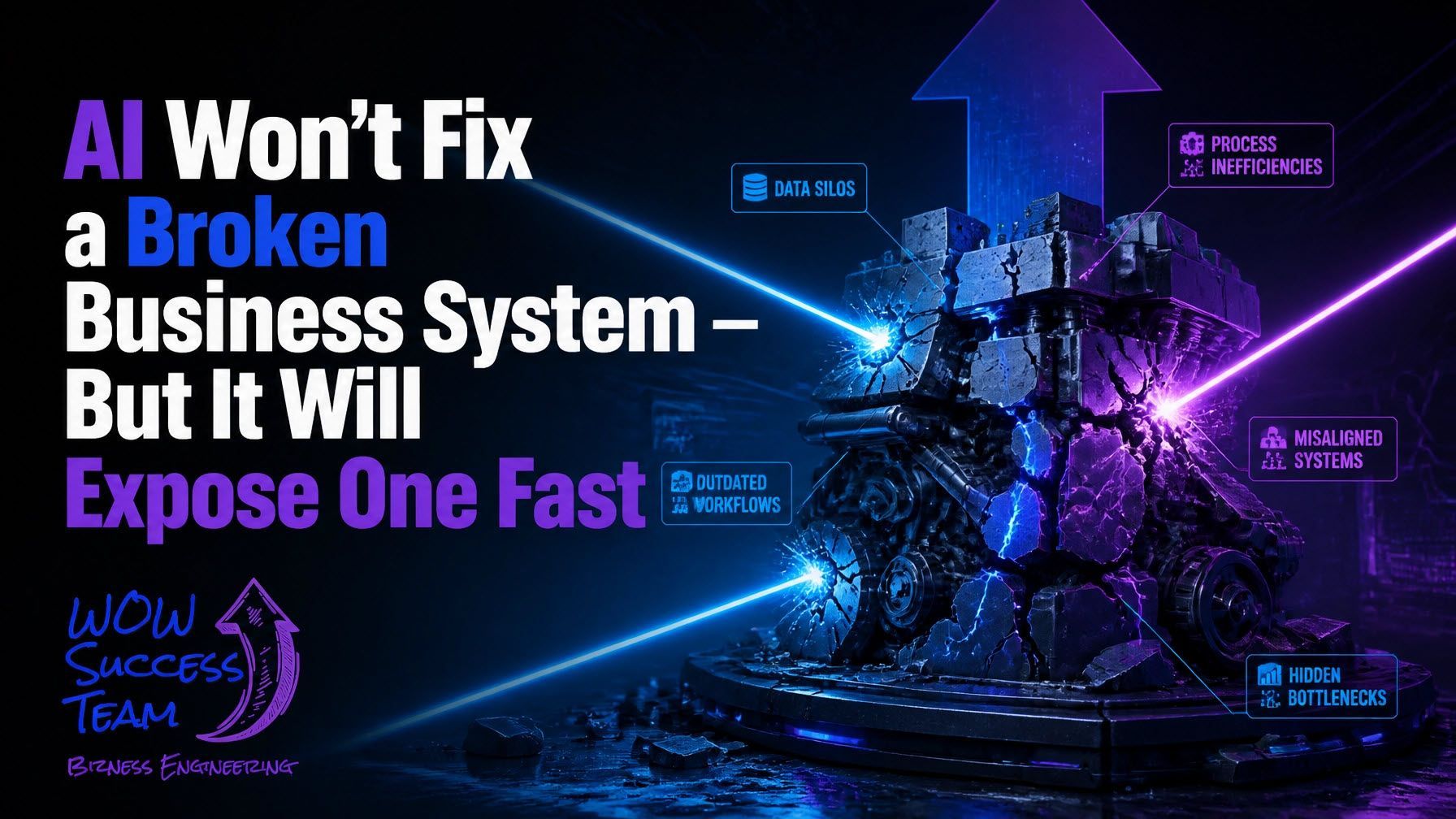
Common leaks include unclear lead ownership, delayed follow-up, duplicate data entry, missing handoff steps, inconsistent client onboarding, vague task status, scattered documents, and decision-making that requires the owner to inspect everything manually.
A helpful test is to ask, "If our best person were unavailable for two weeks, would this process still run cleanly?" If the answer is no, the business most likely does not need more software. It most likely needs a clearer operating path.
What to fix before adding AI
The goal is not to document every tiny detail before using technology. The goal is to create enough clarity so that the technology has something stable to support.
Start with one process that matters: lead intake, follow-up, onboarding, project handoff, billing, customer support, or weekly visibility. Define the trigger that starts the process, the owner of each step, the information that must be captured, the decision points, the tools involved, and the outcome that tells you the process is complete.
Once that is clear, AI can help reduce friction. It might draft a response, summarize an intake form, route a request, create a task, flag missing information, or prepare a weekly visibility summary. But the human-guided approval path still matters, especially anywhere the decision affects a client, a deadline, money, or brand trust.

The better question
Instead of asking, "How can we use AI here?" start with, "What problem are we tired of managing over and over? And why is it recurring?"
Those questions change the conversation. It moves the business away from chasing tools and toward engineering better operational paths. It also helps protect the team from adopting technology that adds effort without removing the root cause of the issues.
AI can be a powerful engine inside a business system. But the system still needs a map, a purpose, and a human approval lane. Fix the processes first, then create AI support for the parts of the work that should become faster, clearer, and easier to manage.
Call to Action
If your business feels harder and slower than it should, start with the processes before the platforms. WOWSuccessTeam helps business owners identify the operational leaks, simplify the workflow, and build practical systems that support growth and scalability without adding more noise.
Suggested next step: Schedule a practical business systems conversation.